Your customers don't need a recap. They need a plan.
Usage reports tell customers what happened. A forward-looking strategy review tells them what to do next and what it costs them if they don't. That's the difference between a CSM and a trusted advisor.
About this Blueprint
Most QBRs spend 80 percent of the time looking backward. Customers sit through slides about adoption metrics and feature usage they already know about, and leave without a clear sense of what the next chapter looks like or why it matters.
The forward-looking strategy review flips that ratio. Tell Mutiny which account you're building for and what gap exists between where the customer is today and where they need to be by year-end. Mutiny builds a strategic brief that names the risk of inaction, identifies workflows that close the gap, and locks owners and dates on both sides.
Who This Is For
Customer success managers who want every QBR to feel like a strategic conversation, not a usage review.
Account managers running renewal and expansion plays who need a repeatable way to frame the next investment before the contract comes up.
CS leaders who want to elevate the quality of customer conversations across the entire team without adding coaching overhead.
Best Use Cases
Quarterly business reviews
Instead of a deck that recaps the past quarter, send a page that frames the next one. Customers who arrive at a QBR already looking at a clear plan spend the meeting making decisions, not asking questions.
Expansion conversations
When a customer is ready to grow but hasn't been shown a specific path forward, a strategy review that names the exact workflows that would close their gap gives the conversation a concrete anchor.
Renewal positioning
The best time to build the renewal case is 90 days before the contract is up, not the week of. A forward-looking strategy review started early shows customers you're invested in their outcome, not just their renewal.
What's Included
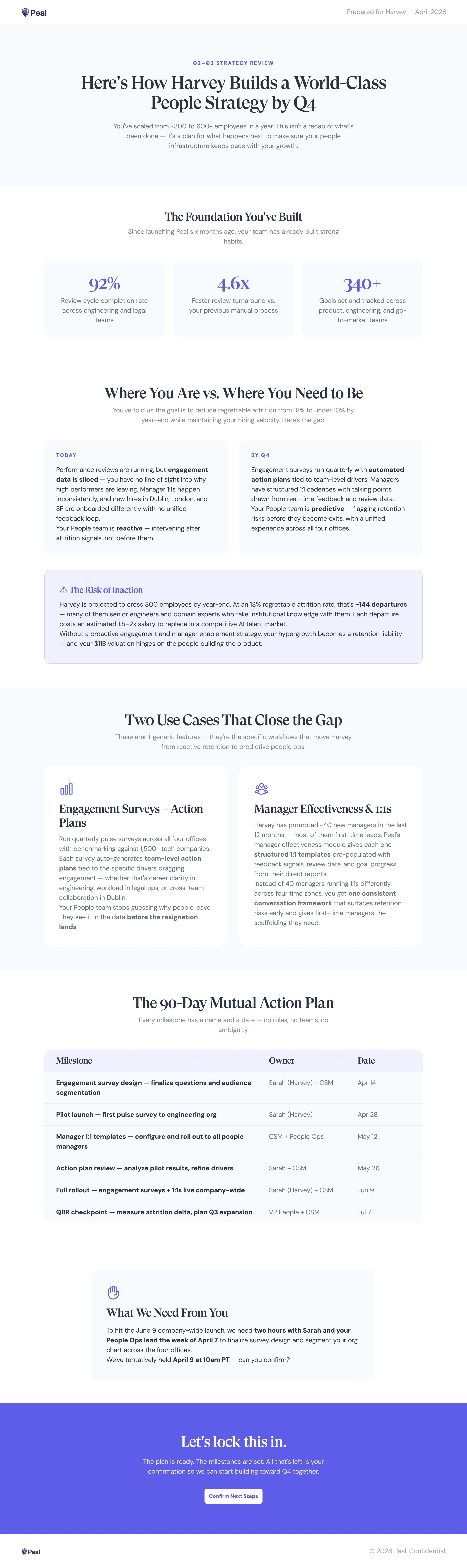
Goal-specific hero
A headline that names the customer and references their stated goal directly. Sets the tone immediately: this page is about what's next, not what's been.
ROI snapshot
A brief proof point section that validates what's working before moving on. Two to three bold stats that earn the right to talk about the future.
Gap analysis
The most important section on the page. Where the customer is today versus where they've said they need to be, laid out clearly with a risk of inaction callout that names what happens if the gap isn't closed.
Use case cards
The one or two workflows that close the gap, each tied specifically to this customer's situation. No generic benefit statements.
90-day outlook
A clean table with milestones, owners, and dates on both sides. Every row has a real name and a real date.
Resource ask
A direct, specific ask for what you need from the customer's side to hit the 90-day outcome. Written like a real request, not a polite suggestion.
Getting Started
Describe the account and where things stand today. Mutiny takes that context and builds the full page: the gap analysis, the 90-day plan, the use case recommendations, and the mutual commitments. The more specific you can be, the sharper the output.
Helpful context includes:
What the customer said they needed to achieve when they started
Where they are today relative to that goal
The one or two workflows or use cases you believe would close the gap
Any commitments or next steps from your last conversation
Names and roles of the key stakeholders on their side
Conclusion
The customers who expand are the ones who always know what their next milestone is and why it matters. A forward-looking strategy review built in Mutiny takes minutes to create and gives every customer that clarity, every quarter, without your CSMs starting from a blank page each time.
Forward Looking Strategy
A strategic review page that is built to drive expansion conversations and secure mutual commitment.
When to use this blueprint
You're heading into a QBR and want to arrive with a clear point of view on what's next, not a usage recap
You're trying to drive an expansion conversation and need something more compelling than a feature announcement
A customer has outgrown their original goals and needs a new horizon to work toward